Posh Boys by Robert Verkaik
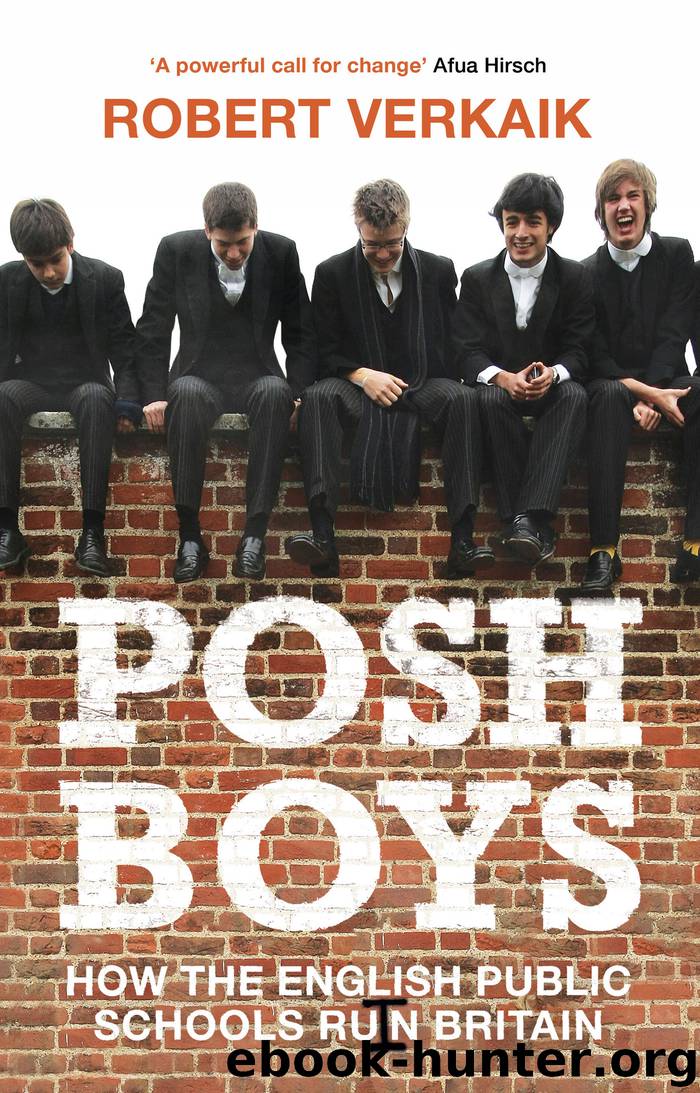
Author:Robert Verkaik [Verkaik, Robert]
Language: eng
Format: epub
ISBN: 9781786073846
Publisher: Oneworld Publications
14
DORMITORIES OF ABUSE
The history of public schools has shown that for long periods our boarding schools were breeding grounds for abuse. Predatory paedophiles and sadists roamed dormitories with impunity. In Georgian and Victorian times abuse was tolerated as part of the toughening up of the schoolboy on his journey to manhood. A succession of inquiries and reports into boarding schools, which began with the Clarendon Commission of 1867 and continued into the 1970s, marked a shift towards a culture which placed children’s welfare at its heart. Gradually attitudes changed and overtly abusive practices and customs were curbed.
But private schools are by definition cloistered communities, and so they will always attract a small number of men who seek to take advantage of a position of trust beyond public scrutiny. Too many times complaints were made and children were either disbelieved or silenced. When cases could not be denied they were hushed up and the teacher quietly moved on. Everything was done in the utmost secrecy. A public school’s reputation is worth millions of pounds in school fees and donations, and bad publicity can be a very costly business. Because public schools are under no obligation to inform the authorities about a case of abuse they have been getting away with it for years.
Now all this paranoia and cover-up is coming home to roost as schools face a deluge of litigation and criminal prosecutions relating to historic, and in some cases not so historic, child abuse. The scale of the claims means that only a very small number of the leading public schools will be untouched by the scandal.
David Greenwood, of Yorkshire-based Switalskis Solicitors, who has won substantial damages for pupils from schools across the country, says his firm is working on new cases involving about a dozen private schools. ‘I’ve seen lots of cases where schools adopt a range of legal tactics, sometimes employing expensive lawyers, first trying to deny allegations because they simply don’t want to face up to the problem,’ he says. ‘There is an institutional response that involves protecting the good name of the school. It means that the people who need to be protected and encouraged to come forward are discouraged.’1
Greenwood says because there are no mandatory reporting rules, the schools rely on the loyalty of teachers and governors to ‘close ranks’ and face down accusers. ‘This pressure to band together is stronger in public schools, partly because it is easier to get sacked from a private school… then the [accused] teacher is moved on to other schools.’ He says that increasingly schools are seeking ‘confidentiality’ agreements to protect their reputation. ‘Whilst I understand that abuse cases can tarnish schools, keeping abuse cases under wraps is exactly the opposite of the openness demanded by all the [child safeguarding and welfare] guidance.’
But the private schools have found a way round the regulations. Astonishingly Greenwood says his investigations have shown that up to 40 per cent of schools do not have a written child safeguarding policy. ‘Schools aren’t doing anything more to protect children than they have done in the past.
Download
This site does not store any files on its server. We only index and link to content provided by other sites. Please contact the content providers to delete copyright contents if any and email us, we'll remove relevant links or contents immediately.
The Brazilian Economy since the Great Financial Crisis of 20072008 by Philip Arestis Carolina Troncoso Baltar & Daniela Magalhães Prates(371081)
International Integration of the Brazilian Economy by Elias C. Grivoyannis(111655)
The Art of Coaching by Elena Aguilar(53726)
Flexible Working by Dale Gemma;(23366)
How to Stop Living Paycheck to Paycheck by Avery Breyer(19841)
Thinking, Fast and Slow by Kahneman Daniel(12561)
The Acquirer's Multiple: How the Billionaire Contrarians of Deep Value Beat the Market by Tobias Carlisle(12441)
The Radium Girls by Kate Moore(12216)
The Art of Thinking Clearly by Rolf Dobelli(10741)
Hit Refresh by Satya Nadella(9270)
The Compound Effect by Darren Hardy(9177)
Tools of Titans by Timothy Ferriss(8624)
Atomic Habits: Tiny Changes, Remarkable Results by James Clear(8538)
Turbulence by E. J. Noyes(8235)
A Court of Wings and Ruin by Sarah J. Maas(8142)
Change Your Questions, Change Your Life by Marilee Adams(7948)
Nudge - Improving Decisions about Health, Wealth, and Happiness by Thaler Sunstein(7874)
How to Be a Bawse: A Guide to Conquering Life by Lilly Singh(7652)
Win Bigly by Scott Adams(7360)
